









Gold remains one of the world’s most trusted financial assets and continues to attract investors and traders during periods of economic uncertainty. Over the long term, gold has delivered strong returns for investors, while its short-term volatility creates multiple trading opportunities for active market participants.
In 2025, gold prices surged by more than 70%, driven by inflation concerns, geopolitical tensions, and uncertainty in global financial markets. In 2026, gold experienced several corrections of more than 10% within days, creating opportunities for traders to enter the market during price pullbacks.
Today, gold trading is accessible to anyone through online platforms, Forex brokers, exchange-traded products, and cryptocurrency-based gold assets. Traders can profit from both rising and falling prices using modern financial instruments.
This guide explains how gold trading works, the best instruments for trading gold online, key market drivers, risks, and how to choose the right broker.
Major Takeaways
Gold is considered a safe-haven asset that often rises during economic instability, inflation, and geopolitical uncertainty. However, short-term corrections and volatility are common.
The global gold market operates almost 24 hours a day during weekdays through exchange and over-the-counter markets.
There are several ways to trade gold online, including CFDs, futures, ETFs, mining stocks, and tokenized gold assets.
Gold prices are strongly influenced by inflation, US dollar strength, interest rates, and geopolitical events.

CFD trading offers a low entry barrier for beginners, while futures trading is generally more suitable for professional traders and larger investors.
What Is Gold Trading?
Gold trading involves buying or selling gold to profit from price movements. The most common trading pair in the financial markets is XAU/USD, which represents the price of one troy ounce of gold in US dollars.
When traders open a buy position on XAU/USD, they expect gold prices to rise. If the market moves upward and the position is closed at a higher price, the trader earns a profit.
A sell position means the trader expects gold prices to decline. In this case, gold is sold at the current market price and later repurchased at a lower price to generate profit from the difference.
For example, if XAU/USD is trading at 4,510.00, it means one troy ounce of gold costs 4,510 USD.
Gold trading can be done through several instruments:
- Physical gold bars and coins
- Gold CFDs
- Gold futures contracts
- Gold ETFs
- Gold mining company shares
- Tokenized gold assets
Online trading allows investors to speculate on gold price movements without owning physical gold.

How Gold Trading Works
The gold market is influenced by global supply and demand, investor sentiment, inflation, interest rates, and geopolitical events.
Gold is often viewed as a store of value during periods of uncertainty. When stock markets become unstable or inflation rises, investors frequently move funds into gold as a protective asset.
Gold prices are quoted in US dollars, meaning there is a strong relationship between the USD and gold. When the US dollar weakens, gold prices often rise. When the dollar strengthens, gold may decline.
Modern trading platforms provide real-time charts, technical indicators, and analytical tools that help traders identify market trends and trading opportunities.
How to Read a Gold Price Chart
Gold price charts display the historical and real-time movement of XAU/USD prices. Traders use different timeframes and candlestick patterns to analyze market behavior.
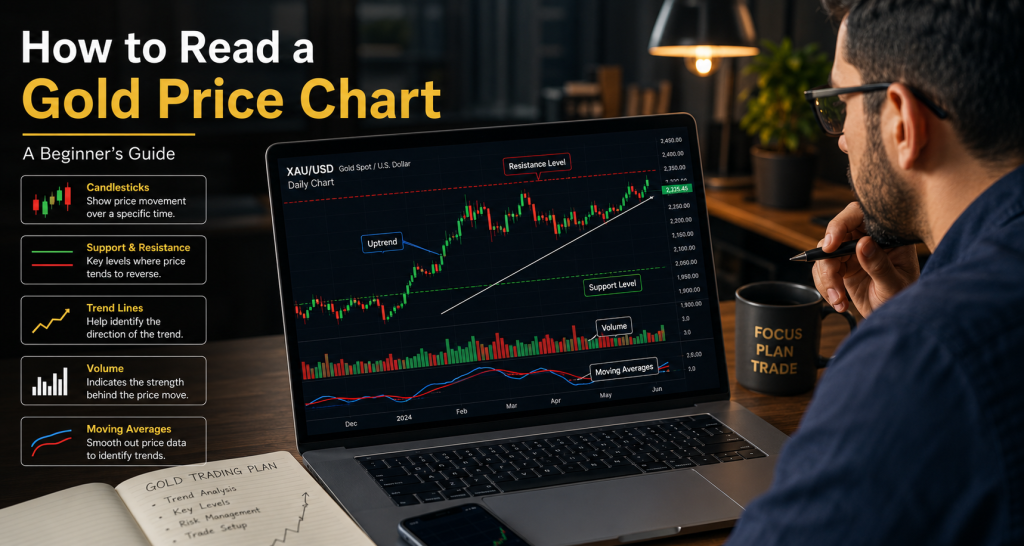
On a four-hour chart, each candlestick represents four hours of price activity. Green candles indicate price increases, while red candles show price declines.
Candlestick bodies display opening and closing prices, while the upper and lower wicks represent the highest and lowest prices during the selected period.
Technical analysis helps traders identify trends, support and resistance zones, and possible reversal points.
Fundamental events such as wars, inflation data, central bank announcements, and geopolitical conflicts can cause sharp price movements and increased volatility in gold markets.
Key Factors Affecting Gold Prices
Monetary Policy
Higher interest rates generally reduce demand for gold because investors move toward higher-yielding assets such as bonds and savings instruments.
Inflation
Gold is commonly used as a hedge against inflation. Rising inflation often supports long-term gold price growth.

US Dollar Strength
Since gold is priced in US dollars, a weaker dollar typically increases gold prices, while a stronger dollar can pressure prices lower.
Geopolitical Risks
Wars, sanctions, economic uncertainty, and political instability increase demand for safe-haven assets such as gold.

Supply and Demand
Gold mining production, industrial demand, jewelry demand, and central bank purchases all influence market prices.
Speculative Trading Activity
Institutional traders, hedge funds, and market makers can create strong short-term price fluctuations through large buy and sell orders.
How the Gold Market Works
The gold market is a decentralized global financial system involving exchanges, banks, institutions, brokers, mining companies, and retail traders.
The London Bullion Market Association is one of the world’s most important physical gold trading centers and determines benchmark gold prices through the London fixing process.
COMEX in New York is a major exchange for gold futures trading and plays a significant role in determining short-term gold price movements.
The Shanghai Gold Exchange is one of Asia’s largest gold trading hubs and reflects strong regional demand for precious metals.
Major market participants include:
- Central banks
- Investment funds
- Retail traders
- Mining companies
- Industrial buyers
- Institutional investors

Gold Trading Hours
Gold trading is available nearly 24 hours a day during weekdays across global financial markets.
Gold futures on CME Globex operate from Sunday evening through Friday evening with a daily technical break.
Over-the-counter Forex brokers usually provide around 23 hours of trading access daily.
Cryptocurrency exchanges offering tokenized gold assets may operate 24/7 without weekend interruptions.
The highest market liquidity generally occurs during the London and New York trading sessions.
Best Instruments for Gold Trading
There are several popular methods for trading gold online depending on investment goals, experience level, and capital size.
CFD Gold Trading
Contracts for Difference allow traders to speculate on gold price movements without owning physical gold.
Advantages include:
- Low starting capital requirements
- Access to leverage
- Fast account setup
- Ability to trade from anywhere
- Opportunities to profit in rising and falling markets
CFDs are widely used by beginner and intermediate traders because of their accessibility and flexibility.
Gold Futures Trading
Gold futures are exchange-traded contracts that obligate buyers and sellers to trade gold at a predetermined price on a future date.
Advantages include:
- Strong regulation
- Transparent pricing
- High liquidity
- No overnight swap fees
However, futures trading typically requires larger capital and more advanced trading knowledge.
Gold ETFs
Gold exchange-traded funds allow investors to gain exposure to gold through stock exchanges without owning physical metal.
Popular gold ETFs include:
- SPDR Gold Shares (GLD)
- VanEck Gold Miners ETF
Benefits of gold ETFs include:
- Professional portfolio management
- Easy buying and selling
- Portfolio diversification
- Lower management costs compared to physical storage
Gold ETFs are suitable for long-term investors seeking simplified exposure to precious metals.
Gold Mining Stocks
Gold mining company shares often move in correlation with gold prices. When gold prices rise, mining companies may experience increased profitability and higher share prices.
Mining stocks can sometimes outperform gold itself due to operational leverage and company growth factors.
Advantages include:
- Potential dividend income
- Strong growth opportunities
- Additional exposure to commodity markets
However, mining stocks also carry company-specific risks, operational risks, and broader stock market volatility.
Tokenized Gold Assets
Blockchain technology has introduced tokenized gold assets backed by physical gold reserves.
Popular examples include:
- PAX Gold (PAXG)
- Tether Gold (XAUT)
These digital assets track gold prices and can be traded on cryptocurrency exchanges.
Advantages include:
- 24/7 trading access
- Blockchain transparency
- No physical storage concerns
- Fast transactions
However, tokenized assets also involve platform risks and regulatory uncertainties.
How to Choose the Right Gold Trading Broker
Choosing the right broker is essential for successful gold trading.
Regulation and Licensing
Always select a regulated broker with a valid license from recognized financial authorities.
Trading Costs
Compare spreads, commissions, swap fees, and withdrawal charges before opening an account.
Trading Instruments
A broker offering multiple gold-related instruments provides greater flexibility and diversification opportunities.
Trading Platform and Tools
Advanced charting tools, indicators, and analysis features improve trading efficiency and decision-making.
Payment Methods
Reliable brokers should support secure deposits and withdrawals through multiple payment options.
Customer Reviews
Detailed and balanced reviews can help identify broker reliability and service quality.
Advantages of Gold Trading
Gold trading offers several important benefits for traders and investors.
High Liquidity
Gold is one of the most actively traded commodities in the world with strong market liquidity.
Long-Term Value Growth
Limited supply and increasing demand support long-term price appreciation.
Safe-Haven Protection
Gold often performs well during financial crises, inflation, and economic instability.
Diversification
Gold helps diversify investment portfolios and reduce overall market risk exposure.
Risks of Gold Trading
Despite its advantages, gold trading also carries risks.
Market Volatility
Gold prices can fluctuate sharply in response to news events and economic developments.
Currency Risk
A stronger US dollar can negatively affect gold prices.
Interest Rate Risk
Higher interest rates reduce the attractiveness of non-yielding assets such as gold.
Geopolitical Uncertainty
Unexpected geopolitical developments can create extreme price swings and market instability.
Risk management strategies such as Stop Loss orders and proper position sizing are essential for controlling losses.
Long-Term Gold Investment Potential
Historically, gold has maintained its role as a long-term store of value. Limited supply, growing industrial demand, and strong investor interest continue to support long-term bullish trends.
Many investors include gold in their portfolios as protection against inflation, currency devaluation, and financial market instability.
Although short-term corrections are common, gold remains one of the most important assets for portfolio diversification and wealth preservation.
Conclusion
Gold trading continues to attract investors and traders worldwide due to its strong liquidity, long-term value growth, and safe-haven status.
There are multiple ways to trade gold online, including CFDs, futures, ETFs, mining stocks, and tokenized assets. Each instrument has different advantages, risks, and capital requirements.
For beginners, CFD trading offers one of the easiest ways to access the gold market with relatively small capital. Long-term investors may prefer physical gold, ETFs, or gold-backed digital assets.
Successful gold trading requires proper risk management, market analysis, and selecting a reliable broker with strong regulation and trading tools.
As economic uncertainty, inflation, and geopolitical risks continue influencing financial markets, gold is expected to remain one of the most important trading and investment assets in 2026 and beyond.