









Gold vs Crude Oil Trading Strategy: The Complete Guide to Market Trends & Risk Management
Commodity trading has become one of the most attractive markets for traders seeking diversification beyond traditional forex pairs. Among all commodities, Gold (XAU/USD) and Crude Oil (WTI & Brent) remain the two most actively traded assets due to their high liquidity, global demand, and significant price movements.
Understanding the differences between these two markets is essential for developing a profitable trading strategy. While gold is widely considered a safe-haven asset, crude oil reflects the health of the global economy and energy demand.
In this comprehensive guide by Gulf Star Pro, you’ll learn the best Gold vs Crude Oil trading strategies, how to manage trading risks, and when each market offers the highest probability trading opportunities.
Understanding Gold Trading
Gold has maintained its value for centuries and continues to serve as a hedge against inflation, currency depreciation, and geopolitical uncertainty.
Traders often buy gold when:
- Inflation increases
- The US Dollar weakens
- Global conflicts rise
- Stock markets decline
- Central banks cut interest rates
Gold generally performs well during periods of economic uncertainty because investors seek safer investments.
Understanding Crude Oil Trading
Crude oil is one of the world’s most important energy commodities. Unlike gold, crude oil prices mainly depend on supply and demand.
Major factors influencing oil prices include:
- OPEC production decisions
- Global economic growth
- Supply disruptions
- Geopolitical tensions
- US crude inventory reports
- Seasonal energy demand
Oil prices can experience sharp volatility, creating excellent opportunities for short-term traders.
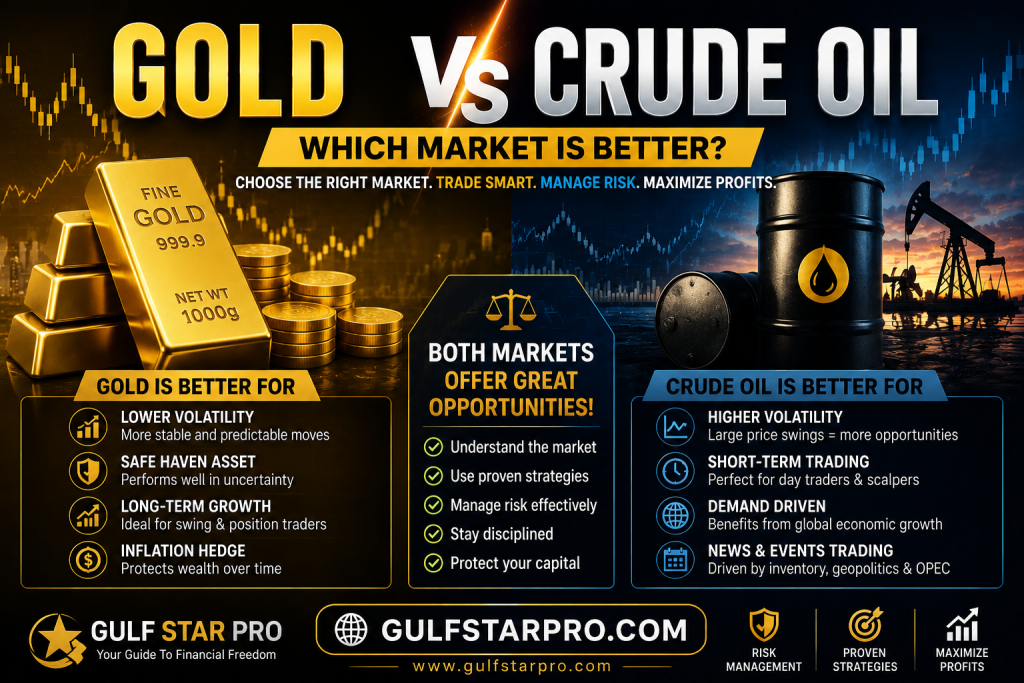
Gold vs Crude Oil: Key Differences
| Feature | Gold | Crude Oil |
| Market Nature | Safe Haven | Growth Asset |
| Volatility | Moderate | High |
| Best During | Economic Crisis | Economic Expansion |
| Main Driver | Inflation & Interest Rates | Supply & Demand |
| Suitable For | Swing Traders | Day Traders & Scalpers |
| Risk Level | Medium | High |
Best Gold Trading Strategy
1. Trend Following Strategy
Use:
- 50 EMA
- 200 EMA
- RSI (14)
Buy Signal
- Price above 200 EMA
- 50 EMA crosses above 200 EMA
- RSI above 50
Sell Signal
- Price below 200 EMA
- 50 EMA crosses below 200 EMA
- RSI below 50
2. Breakout Trading
Gold often breaks out after major economic news such as:
- US Non-Farm Payrolls
- FOMC Meetings
- CPI Reports
Wait for confirmation before entering a trade.
Best Crude Oil Trading Strategy
Inventory Report Strategy
Every week, traders closely watch the US Crude Oil Inventory Report.
Generally:
- Lower inventories → Oil prices rise
- Higher inventories → Oil prices fall
Avoid entering trades before the news release unless you have a clear risk management plan.
Trend + Pullback Strategy
Indicators:
- 20 EMA
- 50 EMA
- MACD
Trade only in the direction of the primary trend.
Gold and Oil Correlation
Gold and crude oil do not always move in the same direction.
However, during periods of high inflation:
- Rising oil prices often increase inflation.
- Higher inflation may boost gold demand.
During recessions:
- Oil demand usually falls.
- Gold demand often increases.
Understanding this relationship helps traders identify broader market sentiment.
Risk Management: The Key to Long-Term Success
Even the best trading strategy can fail without proper risk management.
Professional traders focus on preserving capital before seeking profits.
Risk Management Rules
Never Risk More Than 1–2%
Limit every trade to 1–2% of your total trading capital.
Always Use Stop Loss
A stop loss protects your account from unexpected market movements.
Never trade without one.
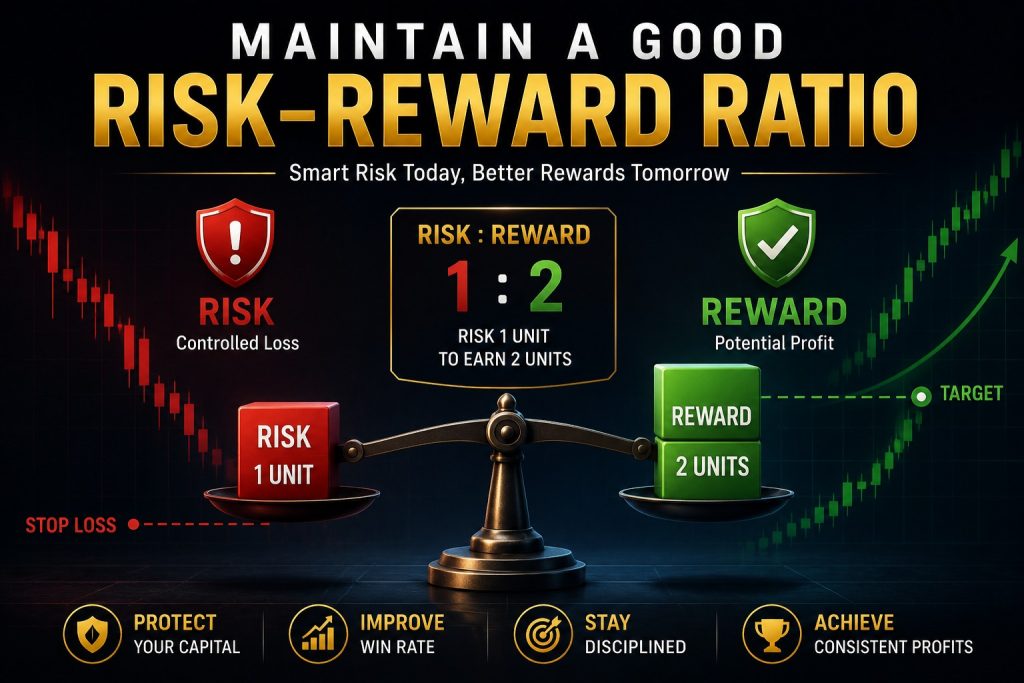
Maintain a Good Risk-Reward Ratio
Aim for at least:
Risk:Reward = 1:2
Example:
- Risk: $100
- Potential Profit: $200
Avoid Overtrading
Quality trades outperform quantity.
Wait patiently for high-probability setups instead of forcing trades.
Diversify
Avoid placing all your capital into a single commodity.
A balanced portfolio reduces overall risk.
Common Mistakes Traders Make
Many beginner traders lose money because they:
- Trade without a plan
- Ignore stop losses
- Over-leverage positions
- Let emotions control decisions
- Chase the market after missing entries
- Risk too much on a single trade
Recognizing these mistakes early can significantly improve long-term performance.
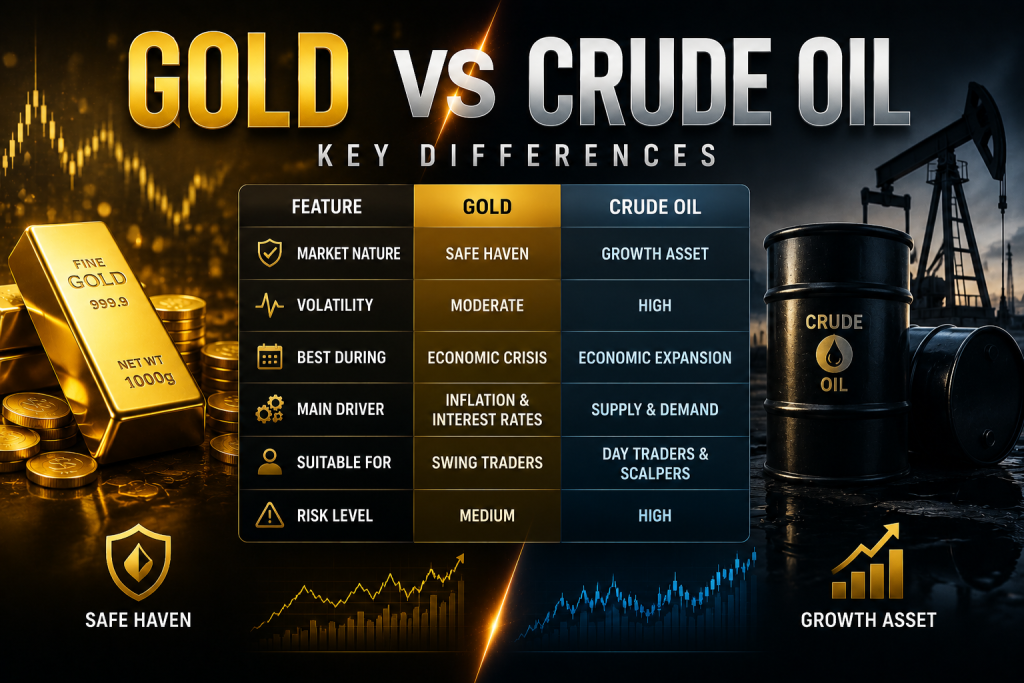
Which Market Is Better?
Gold is ideal for traders who prefer:
- Lower volatility
- Stable trends
- Long-term investing
Crude oil is better suited for traders who enjoy:
- High volatility
- Fast-moving markets
- Intraday opportunities
Ultimately, the best market depends on your trading style, risk tolerance, and experience.
Final Thoughts
Gold and crude oil are two of the most rewarding commodity markets, but they require different approaches. Gold often performs well during uncertainty, while crude oil thrives on economic activity and supply-demand dynamics.
By combining technical analysis, understanding market fundamentals, and following disciplined risk management practices, traders can increase their chances of long-term success. Remember that no strategy guarantees profits, but consistency, patience, and proper capital management are the foundations of sustainable trading.
At Gulf Star Pro, we encourage traders to continuously learn, adapt to changing market conditions, and prioritize protecting their capital above all else.
Frequently Asked Questions (FAQ)
Is gold safer to trade than crude oil?
Generally, yes. Gold tends to have lower volatility and is considered a safe-haven asset, while crude oil often experiences larger price swings due to supply and demand changes.
What is the best risk-reward ratio for commodity trading?
Many professional traders aim for a minimum risk-reward ratio of 1:2, meaning they seek at least $2 in potential profit for every $1 they risk.
Can beginners trade gold and crude oil?
Yes, but beginners should start with a demo account, use strict risk management, and avoid overleveraging before trading with real money.
Why do gold and crude oil sometimes move in opposite directions?
Gold often rises during economic uncertainty as investors seek safety, while crude oil may fall when global demand weakens. During inflationary periods, however, both can sometimes rise together.






Thanks for this informative article